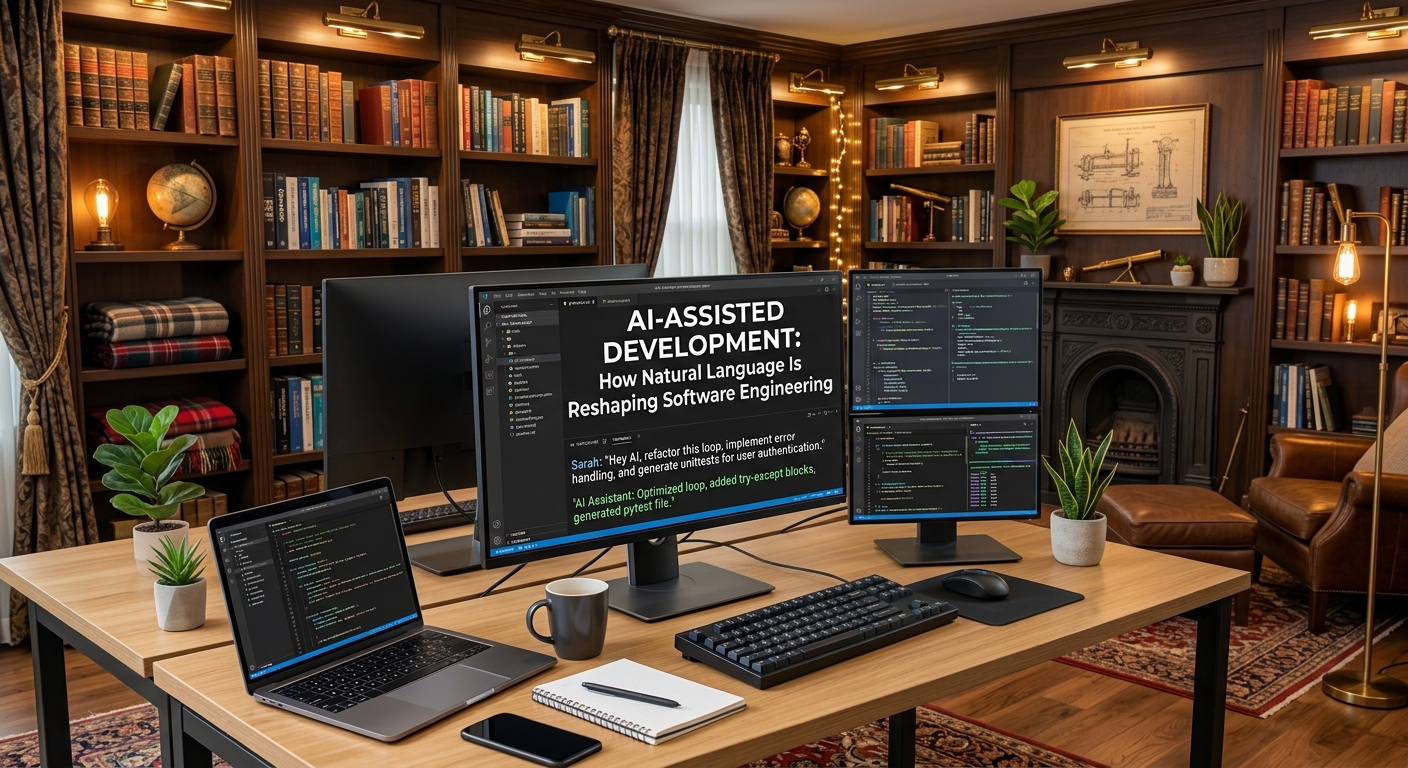
How AI is changing the way developers think, build, and ship software
For decades, building software has meant writing code line by line, debugging syntax errors, consulting documentation, and carefully assembling every component of an application by hand. Artificial intelligence is changing that process. With tools now capable of interpreting natural language and generating functional code, developers can describe what they want to build and see software take shape around that description. This shift is often referred to as "AI-assisted" or "prompt-driven" development.
This approach goes beyond simply asking an AI tool to produce a few lines of code. It represents a different way of interacting with software development itself. Rather than beginning with the question "How do I implement this?", developers increasingly start with "What should this do?" They describe the desired functionality, interface, or workflow in natural language, and AI helps translate that intent into working code.
This changes the developer's role. Instead of spending the majority of their time manually constructing every component, developers increasingly act as architects, reviewers, and decision-makers. The developer defines the direction, AI generates implementation options, and the human evaluates, refines, and approves the result.
From Syntax to Intent
Traditional development typically begins with technical decisions: frameworks, database structures, APIs, components, and design patterns are considered before the user experience takes final shape.
AI-assisted development shifts more of that early thinking toward intent. A developer might describe a dashboard that allows administrators to manage users, monitor transactions, and generate reports. Rather than manually creating every controller, model, route, and interface, AI can help generate much of the underlying implementation.
As a result, the most valuable skill is no longer solely the ability to write code. It is the ability to understand what the software needs to accomplish and to communicate that clearly and precisely.
The Developer Remains Essential
This shift does not make developers less relevant — if anything, a strong understanding of software architecture becomes more important.
AI can generate code quickly, but that code still requires review, testing, and validation. Generated output can misinterpret requirements, introduce inefficient logic, overlook security considerations, or function correctly in one context while failing in another.
The developer's role increasingly centers on direction and judgment. AI can produce a range of possible implementations, but humans remain responsible for determining whether those implementations are correct, secure, maintainable, and appropriate for the business.
Faster Prototyping
One of the clearest advantages of AI-assisted development is speed. Work that once required days of initial development can often become a working prototype in a fraction of the time. Developers can experiment with interfaces, workflows, and functionality without committing significant time to every implementation detail up front.
This creates an efficient iterative cycle: describe, generate, test, refine, and repeat. The faster this cycle operates, the more ideas a team can evaluate before committing to full production investment.
Speed Requires Discipline
There is a risk in making software easier to create: ease of creation does not guarantee quality. An application can be generated quickly, but that does not make it a well-built application. Weak architecture, insecure authentication, inefficient database queries, duplicated code, and hidden technical debt can all exist beneath a polished interface.
This is why engineering fundamentals remain essential. AI may reduce the amount of code developers need to write by hand, but it does not remove the need for sound architecture, thorough testing, robust security practices, clear documentation, and strong engineering judgment. As software becomes easier to produce, the standards used to evaluate it become more important, not less.
The AI-Native Developer
The developers best positioned to benefit from this shift are not necessarily those who write the most code — they are the ones who understand systems well enough to guide AI effectively.
These developers understand how applications should be structured. They have working knowledge of databases, APIs, security, infrastructure, and user experience. They can break complex requirements into clear instructions and recognize when an AI-generated solution is technically flawed.
In this environment, coding becomes less about typing and more about thinking critically, directing effectively, and validating rigorously.
Where This Is Heading
AI-assisted development is one part of a broader transformation in how software is built. The industry is moving toward development environments where natural language functions as another interface for creating software.
The long-term trajectory points toward increasingly intelligent development environments: developers describe requirements, AI generates components and workflows, automated systems test the implementation, and deployment pipelines move validated applications into production.
The line between describing software and building it continues to narrow.
Looking Ahead
The future of software development is unlikely to be code-free. Rather, it represents a change in developers' relationship with code.
Code will continue to power applications, APIs, databases, and infrastructure. What changes is how much of that code developers need to produce manually.
The profession is moving toward a model in which developers spend less time asking "How do I write this?" and more time asking "What should we build, why does it matter, and is this the right solution?"
That shift — from manual implementation toward strategic direction and rigorous evaluation — represents the real value of AI-assisted development.
Glomex Technologies — Building the future of software, one idea at a time.
Share this post
Know someone who'd enjoy reading AI-Assisted Development: How Natural Language Is Reshaping Software Engineering?