How Glomex Technologies builds, tests, secures and delivers reliable software
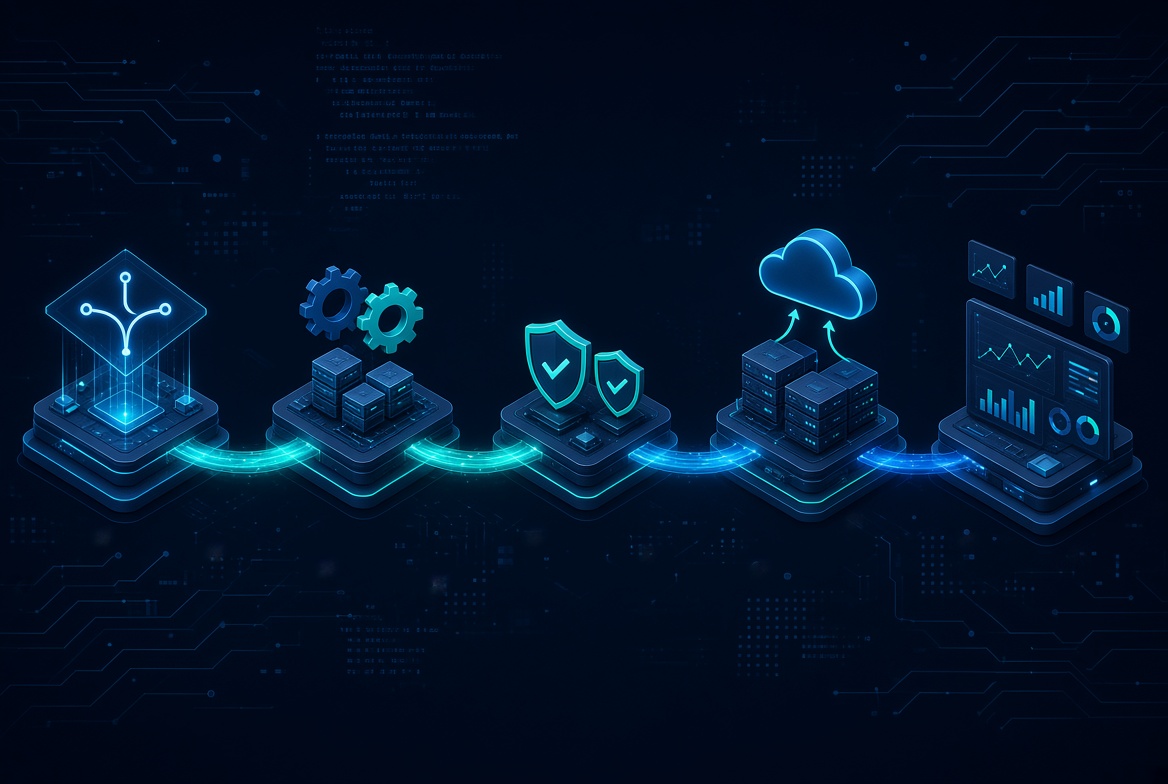
At Glomex Technologies, software development does not end when code is written. Behind every reliable digital solution is a structured engineering process that ensures applications are tested, secured, deployed and continuously improved. Our DevOps pipeline brings development, testing, security, deployment and monitoring together, allowing us to deliver software faster while maintaining quality, consistency and reliability.
From Code to Production
Every release starts with a change in the codebase, whether it is a new feature, bug fix, performance improvement or business requirement. Our development process uses version control to track changes, support collaboration and maintain a clear history of what has been introduced into the application.
Once code is committed, automated processes begin validating the change. Instead of relying entirely on manual checks, our pipeline can automatically run tests, validate the application, build deployment packages and perform other quality checks before the software moves closer to production.
Quality and Security by Design
We believe quality should be built into the software lifecycle rather than checked at the very end. Automated testing helps identify problems early, reducing the risk of defects reaching customers and making issues easier and less expensive to resolve.
Security is treated in the same way. Our DevOps approach incorporates security considerations throughout the delivery process, including dependency validation, secure configuration, access controls and appropriate security checks. This DevSecOps mindset ensures that security is considered alongside functionality and performance.
Consistent Deployment
A major advantage of DevOps is consistency. Software can behave differently when development, staging and production environments are configured manually. Automated builds, containerization, dependency management and controlled configuration help create a predictable path from development to production.
Where required, applications are first deployed to a staging environment where functionality, integrations, database changes and performance can be validated before production deployment. Once the required checks have passed, automated deployment processes can release the application in a controlled and repeatable manner.
Monitoring What Happens After Deployment
Deployment is not the finish line. Once an application is running, we need to understand how it performs in the real world. Monitoring and observability provide visibility into application health, infrastructure resources, errors, response times and system performance.
Depending on the solution, technologies such as Prometheus, Grafana, logging platforms and application monitoring tools can help our engineering teams identify potential issues and respond before they become major operational problems.
Deployment is where the feedback loop begins.
Continuous Improvement
Every release provides valuable information. Monitoring shows us how systems behave, user feedback reveals opportunities for improvement, and deployment outcomes help us refine our engineering processes.
Our DevOps pipeline therefore follows a continuous cycle:
Develop → Test → Secure → Deploy → Monitor → Improve
At Glomex Technologies, our goal is to make software delivery predictable, secure, measurable and continuously improving. We combine modern engineering practices with automation and observability to build digital solutions that can evolve alongside the businesses they serve.
We don't just build software. We build the engineering foundation that allows software to grow with confidence.
Glomex Technologies — Built Different. Built for Impact.
Share this post
Know someone who'd enjoy reading Inside Our DevOps Pipeline?