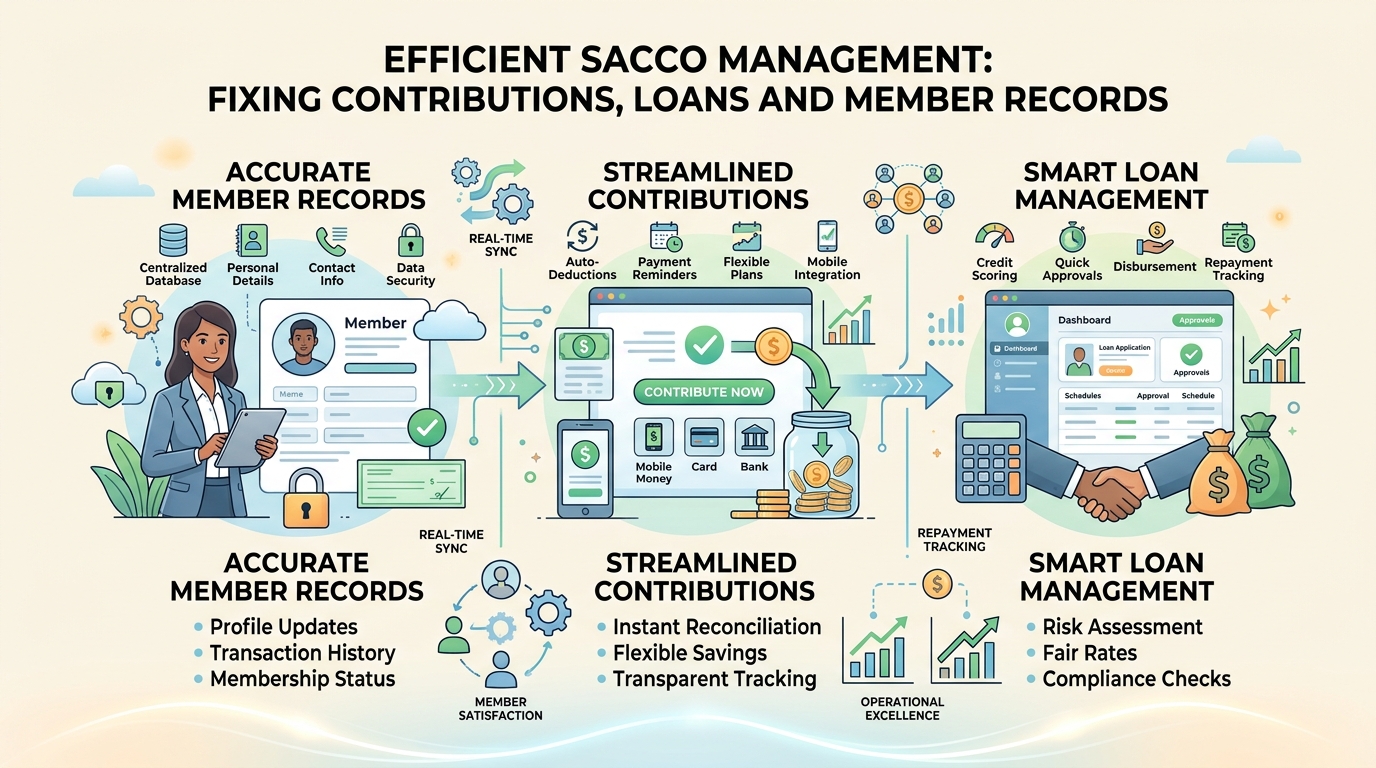
Most SACCOs do not struggle because their members stop saving. They struggle because the work behind those savings grows faster than the office can handle it. More members means more M-Pesa payments to match, more loan applications to check, more guarantors to track and more people calling to ask for their balance. If your team spends the end of every month reconciling spreadsheets late into the evening, the problem is usually not your staff. It is the process.
This post looks at where SACCO operations typically slow down, what efficient management looks like day to day, and practical steps a board or manager can take to get there.
Where SACCO operations usually slow down
Contributions that do not match members
Members pay through M-Pesa, bank deposits, check-off from employers and sometimes cash. Each channel arrives in a different format. A member pays using a spouse's phone, or types the wrong account reference, and someone in the office has to work out whose money it is. Until that is resolved, the member's statement is wrong, and so is any loan eligibility worked out from it.
Loan processing on paper
A typical loan passes through several hands: the member fills a form, a clerk checks savings, the credit committee reviews it, guarantors sign, and finance disburses. When this lives on paper or in email threads, applications wait on desks, files go missing and members cannot tell whether their loan is moving. Slow loans are one of the quickest ways to lose member goodwill.
Guarantors nobody is tracking
Guarantorship is central to SACCO lending, but it is hard to manage manually. Can this member still guarantee another loan? How much of their deposits is already committed? What happens when a borrower falls behind? Without a clear view, SACCOs either over-expose guarantors or refuse sound loans out of caution.
Members calling for their balance
When members cannot see their own records, they phone or visit the office. Every one of those calls takes staff time, and every discrepancy they find becomes a dispute that has to be traced back through months of entries.
Reports that take days to prepare
Boards need monthly figures, the AGM needs annual accounts, and regulators expect accurate returns, whether you report to SASRA or to the Commissioner for Co-operative Development. If each report is assembled by hand from several spreadsheets, it is slow, error-prone and hard to defend when questions come.
What efficient SACCO management actually looks like
Efficiency is not about having the most features. It is about each piece of work being done once, correctly, and visible to the people who need it. In practice that means:
- One member record. Savings, shares, loans, guarantees and dividends all tied to a single member profile, not scattered across files.
- Payments that post themselves. M-Pesa contributions and repayments recorded against the right member automatically, with only the genuine exceptions left for staff to review.
- Loans with a clear workflow. Applications move through defined stages, eligibility is calculated from live data, and everyone can see where a request is and why.
- Guarantor exposure on screen. Before approving a loan, the committee sees exactly what each guarantor already carries.
- Members who can serve themselves. A mobile app, web portal or SMS service where members check balances, download statements and apply for loans.
- Reports on demand. Board packs, loan portfolio summaries and arrears lists generated from the same data the office uses every day.
- An audit trail. Every change recorded with who made it and when, which protects both staff and members.
Practical steps to get there
You do not have to change everything at once. A sensible order of work looks like this:
- Clean up your member data first. Duplicate members, missing ID numbers and outdated phone numbers will undermine any system. Agree on one master list before anything else.
- Map your current processes. Write down how a contribution, a loan and a withdrawal actually move through the office today, including the informal workarounds. This shows where the delays really are.
- Automate payment collection. Integrating M-Pesa paybill payments directly with member accounts usually removes the biggest single source of manual work and disputes.
- Put loans into a workflow. Define the stages, approvals and rules your by-laws and credit policy require, and let the system enforce them consistently.
- Give members visibility. Once the data is reliable, open it up through statements by SMS, a portal or an app. Members trust what they can see.
- Train staff and run in parallel. Run the old and new methods side by side for a period, compare results, and switch over only when the numbers agree.
Where technology helps, and where it does not
Software will not fix weak credit policy, unclear by-laws or poor governance. If the board has not agreed on lending rules, a system will simply apply unclear rules faster. The best results come when the SACCO first agrees how things should work, then uses technology to make that consistent.
Where technology does help is in removing repetitive work and human error from tasks that follow clear rules: matching payments, calculating interest and eligibility, sending reminders, producing statements and compiling reports. It also gives managers early warning, for example by flagging loans that are starting to fall into arrears so the team can follow up before they become bad debts.
AI can add another layer, such as answering routine member questions, summarising arrears trends for the board or helping staff draft member communications. It should support your staff's judgement, not replace it, particularly where lending decisions are concerned.
How Glomex helps SACCOs and chamas
Glomex Technologies works with SACCOs and chamas across Kenya and the wider region. Depending on where you are, that can mean:
- Our Groups and Chama Management platform, a ready-made system for contributions, loans, guarantors, statements and reports, with M-Pesa payments and SMS built in.
- Payment gateway integrations that connect your paybill to member accounts so contributions and repayments post automatically.
- Bulk SMS for contribution receipts, loan reminders, AGM notices and balance alerts.
- Mobile applications and member portals so members can check records and apply for loans without visiting the office.
- Custom software and enterprise systems for larger SACCOs whose products, check-off arrangements or reporting needs go beyond a standard platform.
- AI and intelligent automation for member support, arrears monitoring and reporting.
- IT consulting and managed support to help with data migration, staff training and keeping systems running reliably after launch.
We start by understanding how your SACCO actually works, not by forcing it into a template.
Let us look at your situation
If your SACCO is growing but the back office is not keeping up, or members are losing patience with slow loans and unclear statements, it may be time for a different approach. Get in touch with the Glomex team and tell us how things work today. We will help you identify where the time goes and what a practical, affordable next step would look like for your members and your staff.
Share this post
Know someone who'd enjoy reading Efficient SACCO Management: Fixing Contributions, Loans and Member Records?