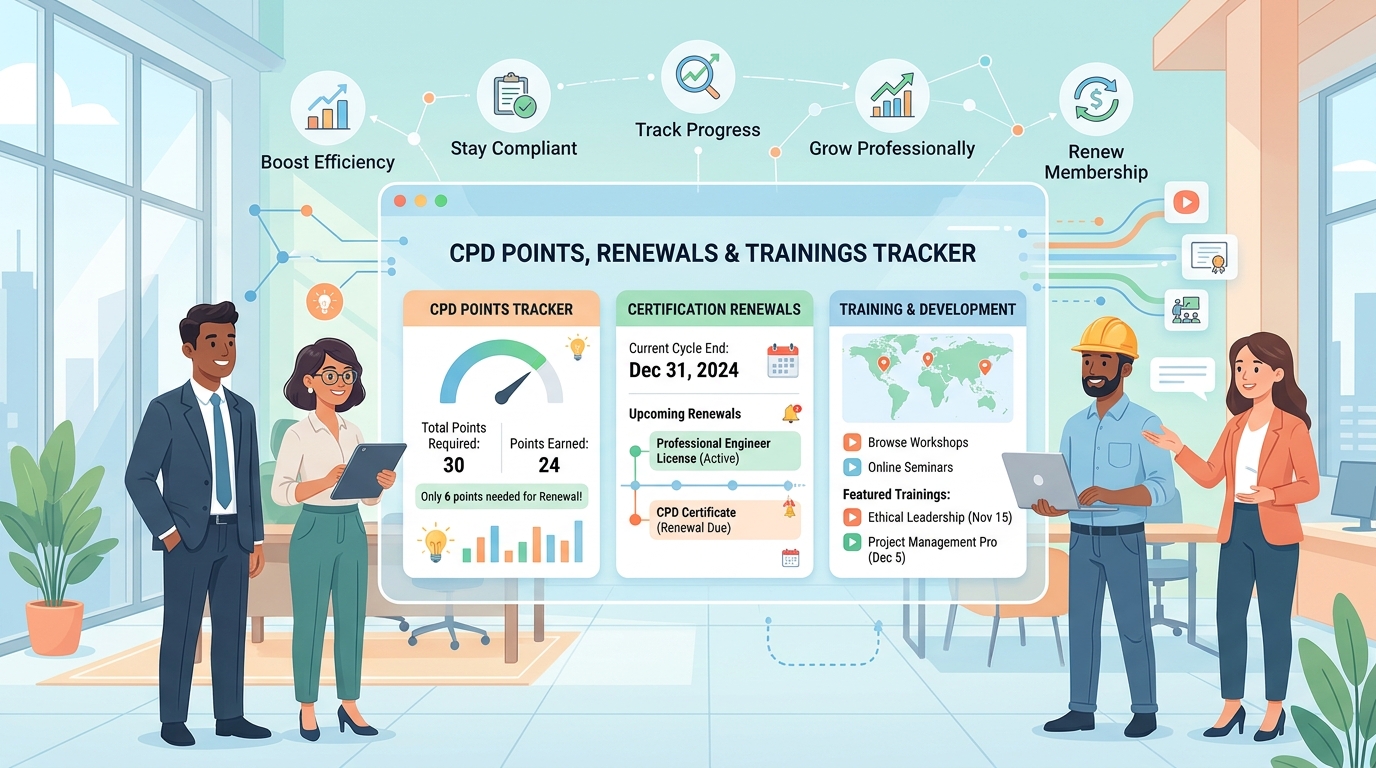
Running a professional association, institute or member-based society in Kenya means keeping a lot of promises at once. Members expect their records to be correct, their CPD points to be counted, their renewal reminders to arrive on time and their certificates to be ready when an employer or regulator asks. Behind the scenes, many secretariats are still doing this with a mix of spreadsheets, paper attendance sheets, M-Pesa statements and a shared inbox.
It works, until it doesn't. This post looks at where membership management usually breaks down, what a good system should do about CPD, renewals and trainings, and how to move to one without disrupting your members.
Where the pressure really comes from
Most membership bodies don't struggle because the work is complicated. They struggle because the same information lives in too many places and has to be reconciled by hand.
- Renewals arrive through several channels. Some members pay by M-Pesa Paybill, some by bank transfer, some at an event desk. Someone then has to match each payment to a member, often with an unclear account reference.
- CPD points are recorded after the fact. Attendance sheets from a workshop in Mombasa or Kisumu reach the office days later, get typed up, and only then are points added to members' records.
- External CPD is hard to verify. Members attend conferences or online courses run by others and send certificates by email or WhatsApp. Reviewing and approving them is slow and inconsistent.
- Good-standing letters take time. When a member needs proof of membership for a job, a tender or a licence, staff have to check payment and CPD status manually before issuing anything.
- Communication is scattered. Renewal reminders, training announcements and AGM notices go out on different lists, and some members never get them.
The result is frustrated members, an overstretched secretariat and leadership that can't easily see who is active, who has lapsed and how training programmes are performing.
What good CPD tracking looks like
Continuing professional development is often the most valuable thing a professional body manages, and the most fiddly. Each body sets its own rules, so a system must be configurable rather than built around one fixed model.
Points that reflect your rules
A membership platform should let you define CPD categories, such as structured training, conferences, self-study, mentoring or publishing, with the points or hours each one carries. It should support annual targets, caps per category and different requirements for different membership grades, so a student member and a fellow are not measured the same way.
Points awarded at the point of attendance
When attendance is captured digitally, for example by scanning a QR code at the venue or confirming an online session, points can be credited to the member's record straight away. No more waiting for paper registers to be typed up, and far fewer disputes about who was actually there.
A simple route for external CPD
Members should be able to log external activities themselves, upload evidence and track the status of their claim. Staff or a CPD committee then review submissions in one queue, approve or query them, and leave a clear audit trail. This is also an area where carefully applied AI can help, for instance by reading an uploaded certificate and pre-filling the course name, date and provider for a human reviewer to confirm. The decision should stay with your people.
Members who can see where they stand
A member portal or mobile app showing points earned, points outstanding and upcoming eligible trainings changes behaviour. Members stop emailing the secretariat to ask, and they plan their CPD through the year rather than rushing in the final month.
Renewals without the year-end scramble
Renewal season often lands on a small team all at once. A better approach spreads the load and removes manual matching.
- Automated reminders. Bulk SMS and email reminders sent at set intervals before and after the renewal date, personalised with the member's name, grade and amount due.
- Direct M-Pesa payment. Members pay through an STK push from the portal or app, so the payment is linked to their record automatically instead of relying on them to type the right reference.
- Instant receipts and status updates. Once payment is confirmed, the member's status changes to active and a receipt is issued without staff involvement.
- Clear rules for lapsed members. Grace periods, reinstatement fees and arrears can be applied consistently by the system rather than decided case by case.
- Self-service certificates. Members in good standing download their membership certificate or good-standing letter themselves, with a verification code an employer can check online.
Linking renewals and CPD is where real value appears. If your rules require a certain level of CPD for good standing, the system can flag members who have paid but are short on points, and prompt them before it becomes a problem.
Trainings and events in the same place
Many associations run workshops, webinars, seminars and annual conferences, both as a service to members and as a source of income. When training management sits in the same system as membership, a lot of duplicated work disappears.
- Publish a training calendar showing CPD points for each session.
- Offer member and non-member pricing automatically based on status.
- Take registration fees through M-Pesa and issue digital tickets or confirmations.
- Capture attendance on the day and award CPD points automatically.
- Send certificates of attendance once the session closes.
- Collect feedback to improve future programmes.
Leadership can then see which trainings members value, which regions are under-served and how training income compares across the year.
Reports leadership can actually use
Councils and boards need more than headcounts. A well-built system gives them up-to-date views of active versus lapsed members, renewal income against expectations, CPD compliance by grade or county, and training attendance trends. Those figures support better decisions and make reporting to members at the AGM far easier to prepare.
Moving across without losing members' trust
Switching systems can feel risky, especially when members' CPD histories are at stake. A sensible migration usually involves:
- Cleaning and importing existing member records and past CPD data before launch.
- Running the new system alongside the old process for a short period.
- Starting with one module, often renewals, and adding CPD and trainings once staff are comfortable.
- Giving members simple guidance by SMS and email on how to log in and what has changed.
- Making sure member data is handled carefully and in line with Kenya's data protection expectations.
How Glomex can help
Glomex builds membership platforms around the way your organisation actually works. We bring together the pieces you need: a member portal and mobile app, configurable CPD rules, M-Pesa payment integration, Bulk SMS, event and training management, certificate generation and practical AI where it genuinely saves time. Because we also build custom software, we can shape the system to your grades, rules and workflows rather than forcing you into a generic template, and we provide managed support after launch.
Let's talk about your members
If your secretariat is spending renewal season matching payments and chasing attendance sheets, it doesn't have to stay that way. Tell us how your association handles membership, CPD and trainings today, and we'll walk you through what a practical, well-fitted system could look like for you.
Share this post
Know someone who'd enjoy reading Tracking CPD Points, Renewals and Trainings for Professional Associations?