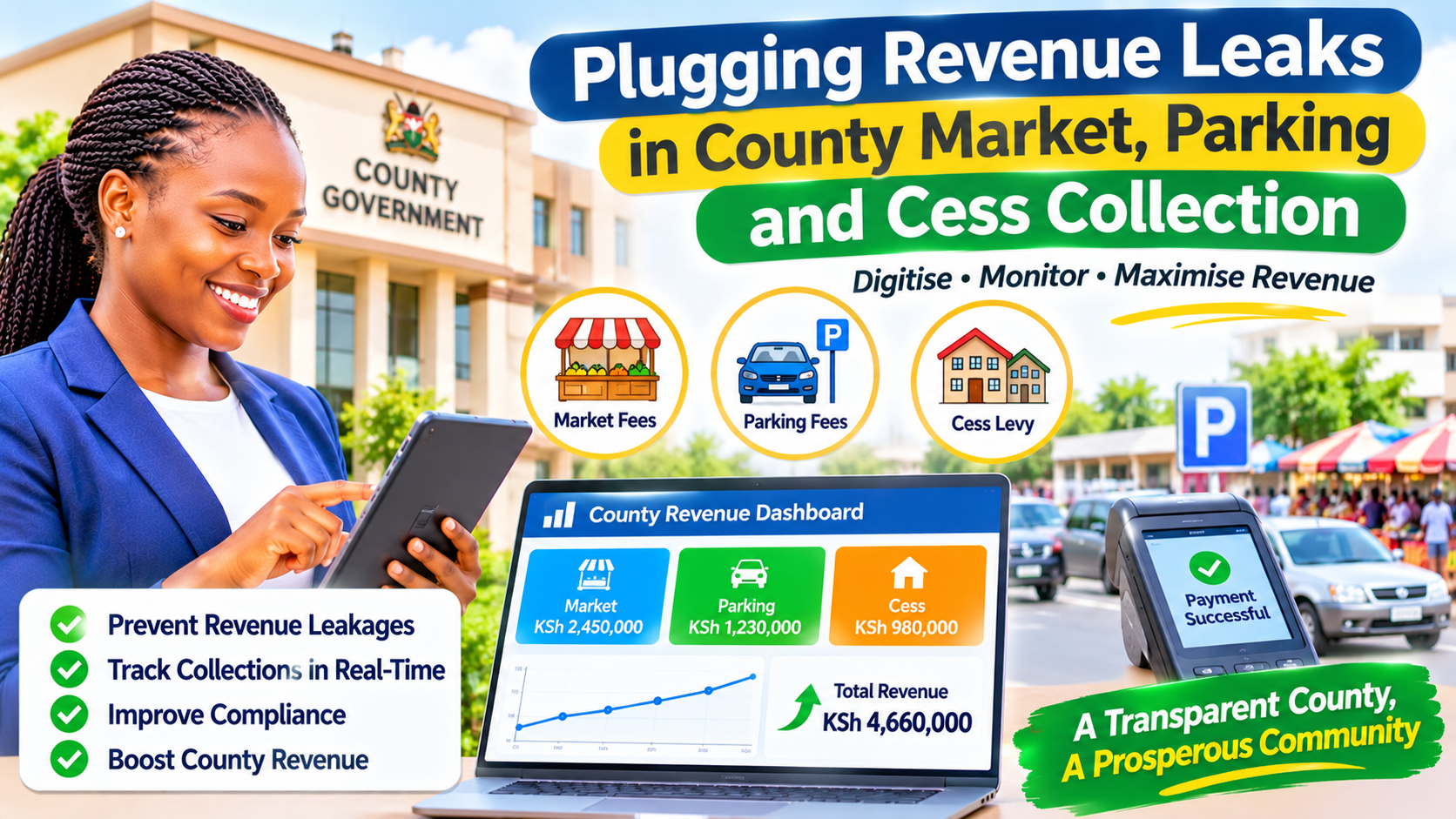
Most county finance teams already know their own-source revenue could be higher. The traders are in the market every morning, the matatus park in town every day and the lorries pass the cess barriers all week. Yet the money that reaches the county account rarely seems to match the activity anyone can see on the ground.
The gap is not usually one dramatic fraud. It is a slow leak made of many small things: cash that changes hands without a receipt, paper receipt books that go missing, collectors who cannot be supervised in real time and reports that arrive weeks after the money should have been banked. This post looks at where those leaks come from and what a practical digital collection system changes.
Where county revenue actually leaks
Cash at the point of collection
Wherever a collector accepts cash, there is room for the amount paid, the amount receipted and the amount banked to differ. A trader pays for a daily market ticket, gets a handwritten slip or nothing at all, and the transaction never enters the books. Nobody can prove it happened.
Paper receipt books
Pre-printed receipt books are hard to control. Books get lost, duplicated or used out of sequence. Reconciling them against bank deposits is slow, manual work, and by the time a discrepancy is found, the trail has gone cold.
No live view of collections
Revenue officers often see figures only when collectors return to the office or when a weekly summary is compiled. Without a live picture, it is impossible to spot a market that suddenly reports far less than usual or a collector whose numbers drop on certain days.
Unregistered or out-of-date payers
If the county does not have an accurate register of traders, businesses, plots and vehicles, it cannot tell who should be paying, let alone who has not. Single business permits lapse, new kiosks open and nobody updates the list.
Friction for honest payers
Many residents are willing to pay but find the process slow: queue at an office, fill a form, pay at a separate counter, come back for the permit. When paying is harder than avoiding payment, compliance suffers.
What a digital collection system changes
The aim is simple: every shilling should be paid into a county-controlled channel, linked to a specific payer and service, and visible to the finance team the moment it arrives. In Kenya, that almost always means building around M-Pesa, with card and bank options where they make sense.
1. Payments go straight to the county
Instead of handing cash to a collector, the trader or motorist pays directly to a county paybill or till, or through a USSD menu or simple web page. The money lands in the county account, not in a pocket. The collector's role shifts from handling cash to verifying compliance.
2. Instant, verifiable receipts
Once payment is confirmed, the system issues a digital receipt by SMS, often with a reference code. Enforcement officers can check that code on a basic smartphone app in seconds. Fake or reused receipts become easy to catch.
3. A living register of payers
Every business, stall, plot and vehicle sits in one database with its location, category and payment history. When a permit is due, the system knows. When a new trader starts paying, they are added automatically. Over time the register becomes one of the county's most valuable assets.
4. Automated reminders
Bulk SMS reminders before permit renewals, rates deadlines or seasonal fees nudge residents to pay on time. Messages can include the exact amount and the payment details, so there is nothing to look up.
5. Dashboards for revenue managers
Finance officers and the executive can see collections by revenue stream, sub-county, market and collector, updated through the day. Unusual dips stand out immediately, and targets can be set and tracked with real data rather than estimates.
6. Automatic reconciliation
Because each payment arrives with its transaction reference and payer details, matching receipts to bank statements stops being a monthly headache. Exceptions are flagged for review instead of being hunted down by hand.
Where AI can genuinely help
Artificial intelligence is not a magic fix, but used carefully it adds useful insight on top of clean data:
- Anomaly detection: flagging collectors, markets or barriers whose figures fall outside their normal pattern, so supervisors know where to look.
- Forecasting: estimating expected revenue by stream and season, helping budget teams plan more realistically.
- Compliance targeting: identifying registered businesses that have stopped paying, so enforcement effort goes where it matters.
- Plain-language reporting: letting officials ask questions such as which markets underperformed last month and getting a clear summary.
Any AI flag should prompt a human review, not an automatic penalty. The point is to direct attention, not to replace judgement.
Getting the rollout right
Technology alone does not close revenue gaps. Counties that succeed tend to handle a few practical issues well:
- Start with one or two revenue streams. Markets and parking are often good pilots because they are high-volume and visible. Prove the approach, then expand to permits, cess, rates and health fees.
- Bring collectors along. Collectors who feel threatened will resist. Reposition them as compliance and enforcement officers, train them on the verification app and recognise good performance.
- Keep it simple for residents. Not everyone has a smartphone. USSD and plain M-Pesa payments must work for a mama mboga as easily as a web portal works for a business owner.
- Communicate widely. Use SMS, local radio, chiefs' barazas and market notices to explain how to pay and how to check a valid receipt.
- Plan for connectivity gaps. Enforcement apps should work offline and sync when signal returns, especially in rural markets and remote cess points.
- Protect the data. Payer information must be stored securely with clear access controls and audit logs, so every change can be traced to a named user.
Choosing between off-the-shelf and custom
Every county has its own fee schedule, Finance Act, revenue streams and existing systems. A rigid package may not fit local rates or integrate with what the county already uses. On the other hand, building everything from scratch can be slow. A sensible middle path is a proven core platform for payments, receipting and registers, configured and extended to match the county's specific laws, workflows and reporting needs.
Talk to Glomex about your county's revenue
Glomex Technologies builds county revenue and service platforms with M-Pesa payments, bulk SMS, verification apps, dashboards and practical AI built in. We work with finance and ICT teams to map where money is being lost, pilot a solution on the streams that matter most and scale it across the county at a pace that works for staff and residents.
If your county is ready to see every shilling it collects, get in touch and tell us about your current process. We will be glad to talk it through and suggest a realistic first step.
Share this post
Know someone who'd enjoy reading Plugging Revenue Leaks in County Market, Parking and Cess Collection?