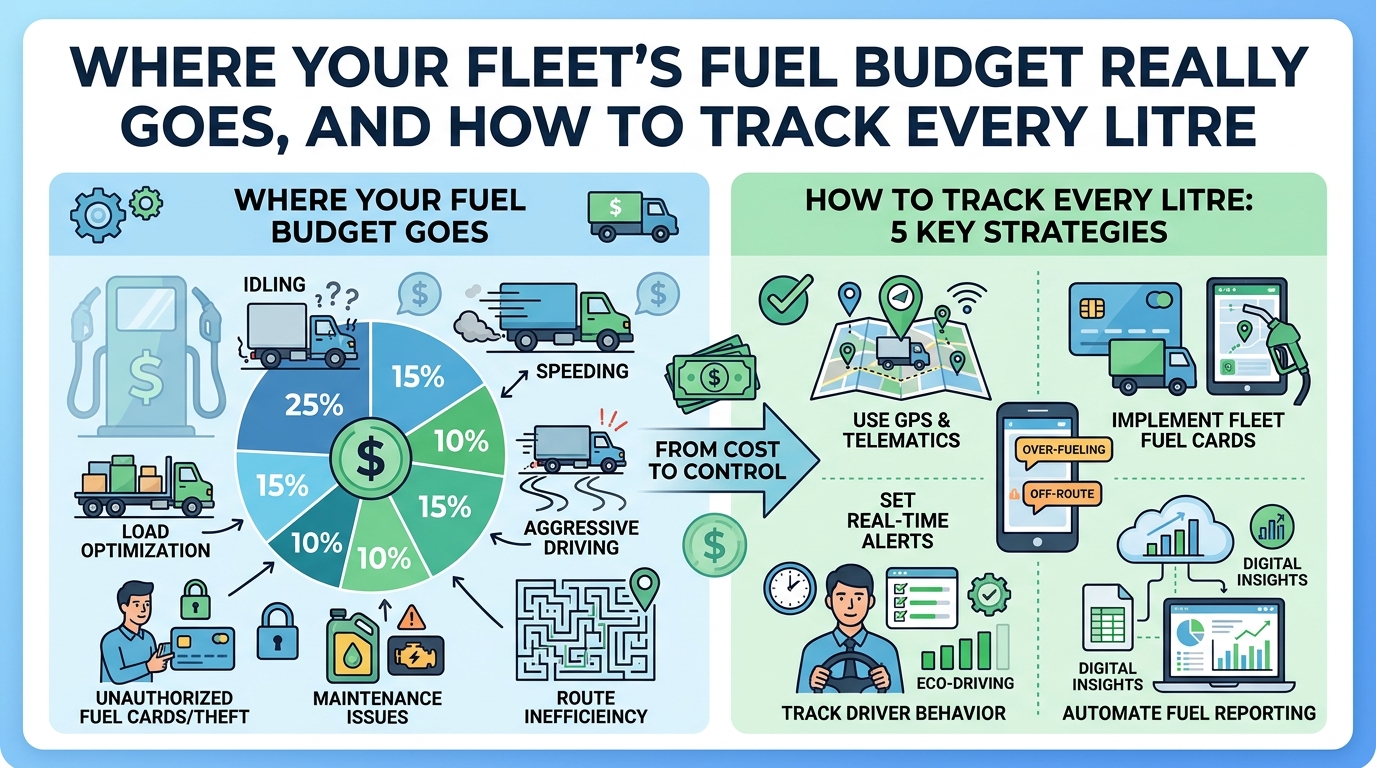
If you run vehicles, whether a county fleet, a distribution business, school buses, an NGO's field cars or a matatu SACCO, fuel is almost certainly one of your largest running costs. It is also one of the easiest to lose control of. Fuel money rarely disappears in one dramatic event. It leaks a little at a time, spread across dozens of vehicles, drivers and petrol stations, until the monthly total no longer makes sense and nobody can say exactly why.
This post looks at where fuel budgets typically leak, why paper logbooks and spreadsheets struggle to catch it, and what a practical fleet management system does differently.
The usual places fuel money disappears
Most fleet managers already suspect some of these. The difficulty is proving which ones apply to their fleet, and on which vehicles.
- Siphoning and partial fills. Fuel is paid for but not all of it ends up in the tank, or some is drained afterwards.
- Inflated or duplicated receipts. A receipt shows more litres than were actually pumped, or the same fill-up is claimed twice.
- Unauthorised trips. Vehicles used for personal errands, side jobs or weekend trips that never appear in the trip log.
- Excessive idling. Engines left running while waiting, loading or sitting in traffic, burning fuel with nothing to show for it.
- Poor routing. Drivers taking longer routes out of habit, or deliveries planned in an order that sends vehicles back and forth across town.
- Neglected maintenance. Underinflated tyres, clogged filters and worn parts quietly push consumption up month after month.
- Loose payment controls. Cash advances and shared fuel arrangements that are never properly reconciled against actual use.
Why logbooks and spreadsheets miss it
Many organisations do keep records. The problem is not a lack of paperwork; it is that the paperwork cannot answer the right questions in time.
- The data is self-reported. The person filling in the logbook is often the same person whose fuel use is being checked.
- It arrives late. By the time receipts are collected and typed into a spreadsheet at month end, the trip is weeks old and nobody remembers the details.
- Nothing is cross-checked. Fuel bought, distance travelled and route taken sit in separate places, if they are recorded at all. Without comparing them, a vehicle that uses far more fuel than it should simply looks like a busy vehicle.
- Patterns stay hidden. One odd receipt is easy to explain away. A steady pattern across one vehicle, one driver or one station only becomes visible when the records are joined up.
What a fuel-aware fleet system actually does
A good fleet management system is not about spying on drivers. It is about getting the basic facts about each vehicle in one place, automatically, so that unusual behaviour stands out on its own.
Ties every fill-up to a vehicle, driver and odometer reading
Each fuel purchase is recorded against a specific vehicle and driver, with the odometer reading at the time. This alone makes it possible to work out real consumption per vehicle rather than guessing from monthly totals.
Compares actual consumption with what is expected
Every vehicle model has a reasonable range of fuel use for the kind of work it does. The system flags vehicles that consistently sit outside that range so a manager can ask why, whether the answer is a mechanical fault, a driving habit or something less innocent.
Combines GPS tracking with fuel records
When trip data from GPS trackers sits alongside fuel records, the questions answer themselves. Did the vehicle actually travel the distance the fuel suggests? Was it at the petrol station when the receipt says it was? Was it moving outside working hours? How long did it spend idling?
Tightens how fuel is paid for
Moving away from loose cash advances towards controlled payments, such as approved M-Pesa till payments or fuel cards linked to specific vehicles, gives you a clean digital record of every transaction. Approvals can follow your existing chain of authority, so a supervisor signs off before money moves.
Sends alerts when something needs attention
Rather than waiting for a month-end report, managers can receive SMS or in-app alerts for things like fill-ups that exceed tank capacity, vehicles moving outside permitted hours or zones, or consumption that suddenly jumps.
Keeps maintenance on schedule
Service reminders based on mileage or dates help prevent the slow rise in consumption that comes from poorly maintained vehicles, and give you a history of what has been done to each one.
A practical way to roll it out
You do not need to change everything at once. A phased approach usually works better and builds trust with drivers.
- Start with clean vehicle and driver records. List every vehicle, its registration, model, tank size and assigned driver or department.
- Digitise fuel purchases first. Even before installing trackers, recording every fill-up with an odometer reading gives you a useful baseline.
- Add GPS tracking to a pilot group. Choose a handful of vehicles, ideally a mix of high and low fuel users, and compare the data for a few weeks.
- Agree the rules openly. Tell drivers what is being tracked and why, what counts as authorised use and how exceptions will be handled.
- Review exceptions regularly. Set a weekly routine for looking at flagged vehicles rather than letting alerts pile up.
- Expand gradually. Once the process works for the pilot group, extend it to the rest of the fleet.
Things to watch out for
- Driver buy-in matters. Systems introduced as punishment tend to be resisted or worked around. Framing them as protecting honest drivers from suspicion works better, and it is usually true.
- Data quality is everything. If odometer readings are skipped or guessed, the comparisons fall apart. Make the required fields genuinely required.
- Do not over-instrument too early. Fuel level sensors and advanced telematics can be valuable, but they need proper installation and calibration. Get the basics working before adding complexity.
- Make reports useful to the people reading them. A finance officer, a transport officer and a director each need a different view. One cluttered dashboard serves nobody well.
Who benefits most
Any organisation with more than a few vehicles can gain from this, but it is especially relevant for county governments managing vehicles across several departments, NGOs accountable to donors for every shilling spent in the field, logistics and distribution businesses where fuel directly eats into margins, schools running transport for learners, and SACCOs overseeing members' vehicles.
Let's look at your fleet
Every fleet is different: the vehicles, the routes, the way fuel is paid for and the people who need the reports. At Glomex, we build fleet management solutions that fit how you actually operate, with GPS tracking, M-Pesa payment controls, SMS alerts and maintenance scheduling working together in one place. If your fuel bills feel higher than they should be and you cannot quite explain why, talk to us about your situation. We will help you work out where the gaps are and what a sensible first step looks like.
Share this post
Know someone who'd enjoy reading Where Your Fleet's Fuel Budget Really Goes, and How to Track Every Litre?