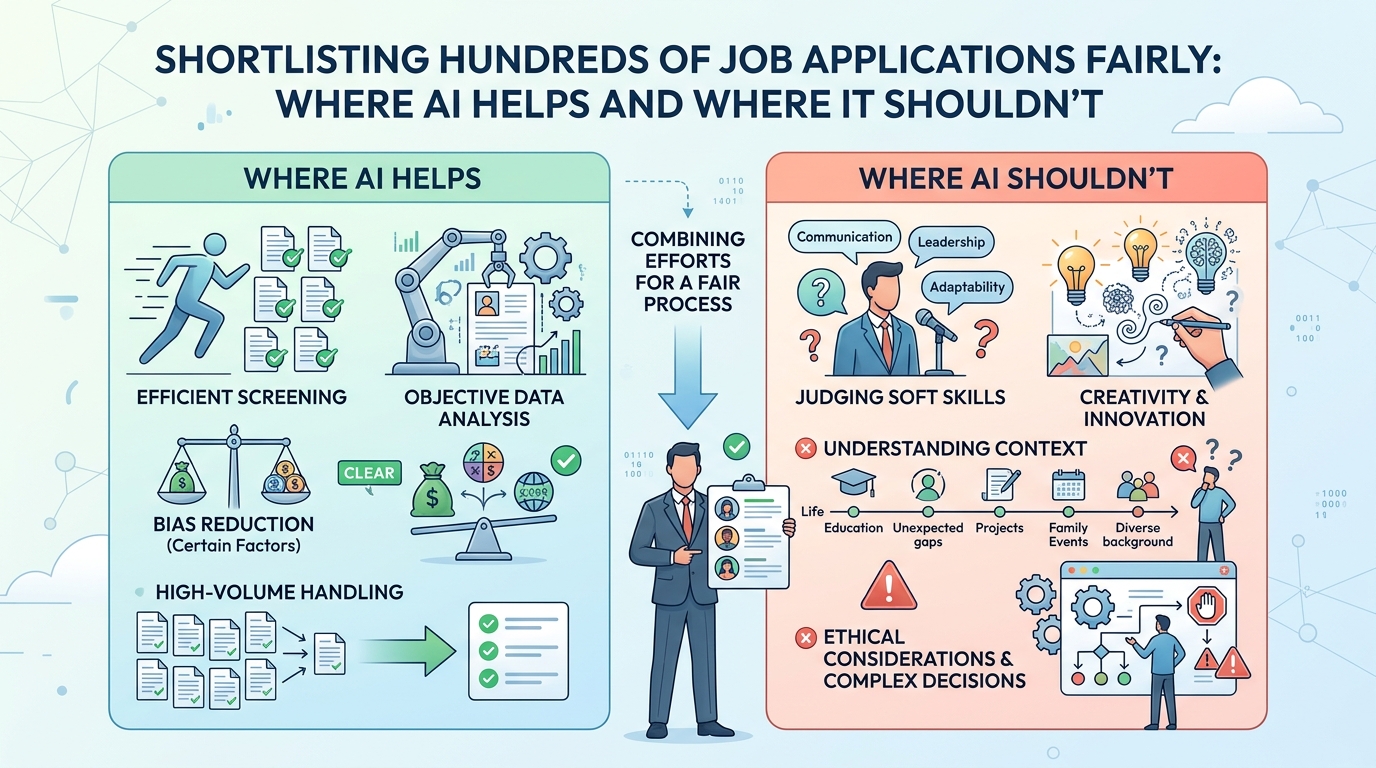
Advertise a vacancy in Kenya and the response can be overwhelming. A single entry-level role at a county public service board, an NGO or a growing business can attract far more applications than any HR team can read properly. These usually arrive as emailed CVs, WhatsApp forwards and hand-delivered envelopes. Someone then has to open every file, check every certificate and build a shortlist before the panel meets.
Under that pressure, three things go wrong. Good candidates get missed because they were buried on page forty of an inbox. Shortlists become inconsistent because different people apply the criteria differently. And when an unsuccessful applicant asks why they were not considered, nobody can give a clear answer.
AI can take a lot of this weight off your team. It is not a magic hiring machine, though, and using it carelessly can make things worse. This post sets out where it genuinely helps, where a human must stay in charge, and how to set it up so your process is faster and fairer.
The real problem is not volume. It is structure.
Most shortlisting trouble starts before anyone reads a CV. When applications arrive in a dozen formats, there is nothing consistent to compare. One applicant lists their degree at the top. Another buries it under hobbies. A third sends a photo of a certificate taken on a phone.
The first fix is therefore not AI. It is a proper recruitment portal that collects applications in a consistent way:
- A structured form for the essentials: qualifications, years of experience, location, availability and professional registration where relevant.
- Document uploads attached to each applicant record rather than scattered across email threads.
- Screening questions tied directly to the minimum requirements in the advert.
- Automatic acknowledgement by SMS or email, so applicants know their submission arrived and stop calling the office.
Once every application sits in the same structure, both people and software can compare like with like.
Where AI genuinely helps
1. Checking minimum requirements
Many applicants simply do not meet the stated minimums: the wrong qualification, too little experience, or a missing mandatory document. Rule-based checks combined with AI that reads uploaded CVs can flag these consistently. Your team then reviews a smaller, cleaner pool instead of rejecting obvious mismatches by hand.
2. Reading unstructured CVs
Even with a good form, the CV holds the detail. AI can pull out job titles, employers, dates and skills, and place them in a standard summary beside the applicant's form answers. A reviewer can then see at a glance whether someone has, for example, three years of hospital procurement experience, without opening a four-page document.
3. Matching against the job description
AI can compare each applicant's summarised experience with the duties and requirements in the advert and suggest how closely they match, with reasons. The important word is suggest. A good system shows why it ranked someone highly, such as relevant roles, matching skills or sector experience, so a human can agree or disagree.
4. Spotting duplicates and inconsistencies
The same person applying several times under slightly different email addresses, dates that overlap impossibly, or certificates that do not match the stated qualification. These are tedious to catch by eye and easy for software to flag for review.
5. Handling communication
Shortlist notifications, interview invitations, reminders and regret messages can all go out automatically by bulk SMS and email. This alone saves hours and makes your organisation look far more professional to candidates.
Where AI should not have the final word
This is where many organisations get it wrong. An AI that silently rejects people is a risk to fairness, to your reputation and, for public bodies, to accountability.
- Final shortlisting decisions. AI should rank and recommend. A named person on your team should approve the shortlist.
- Judging potential. A candidate who changed careers, studied later in life or worked in the informal sector may not look like a neat match on paper. People are better at seeing transferable experience.
- Anything touching protected characteristics. The system should never weigh gender, age, ethnicity, religion, disability or home county unless there is a lawful, documented reason, such as a role with a specific legal requirement. Where your organisation has diversity or inclusion commitments, those should be applied deliberately by people, not inferred by a model.
- Verifying documents. AI can flag that a certificate looks unusual. Confirming whether it is genuine still needs a proper check with the issuing institution.
Building a process you can defend
If an applicant, a board member or an auditor asks how a shortlist was reached, you should be able to show them. A well-built recruitment system makes that straightforward.
- Write the criteria down first. Agree minimum requirements and scoring weights before the advert goes out, not after you have seen the applicants.
- Apply the same rules to everyone. The system screens every application against the same criteria, which removes much of the inconsistency between reviewers.
- Keep a record. Each applicant's file should show what the AI suggested, who reviewed it, what they decided and why.
- Review the AI's output regularly. Look at who it ranks low. If capable people keep being marked down for the same reason, adjust the criteria or the configuration.
- Protect applicant data. CVs contain ID numbers, phone numbers and personal histories. Access should be limited to the people who need it, and data should be handled in line with Kenya's data protection requirements.
Who benefits most
This approach suits any organisation that hires in batches or receives large responses to adverts:
- County governments and public service boards handling mass recruitment where transparency matters.
- Hospitals recruiting nurses, clinical officers and support staff, where professional registration must be confirmed.
- Schools filling teaching and support positions ahead of each term.
- NGOs running project-based hiring across several locations.
- Recruitment agencies managing many clients and a growing talent pool.
Getting started without overhauling everything
You do not need to change your whole HR operation at once. A sensible path is to start with a structured online application portal and automated SMS acknowledgements. Then add AI-assisted CV summaries and minimum-requirement checks. Once your team trusts the outputs, introduce suggested rankings with human approval. Each step brings a visible improvement on its own, and your team keeps control throughout.
Glomex builds recruitment portals with AI screening, document handling, M-Pesa payments where application fees apply, and bulk SMS built in. We can also tailor them to the approval steps your organisation already follows. We design them on the principle in this post: the software does the sorting, your people make the decisions.
Let's talk about your hiring process
If your team is drowning in applications, struggling to keep shortlists consistent, or worried about defending hiring decisions, we would be glad to hear about it. Tell us how you recruit today, how many roles you fill and where the process breaks down. We will help you work out what a practical, fair system could look like for your organisation.
Share this post
Know someone who'd enjoy reading Shortlisting Hundreds of Job Applications Fairly: Where AI Helps and Where It Shouldn't?