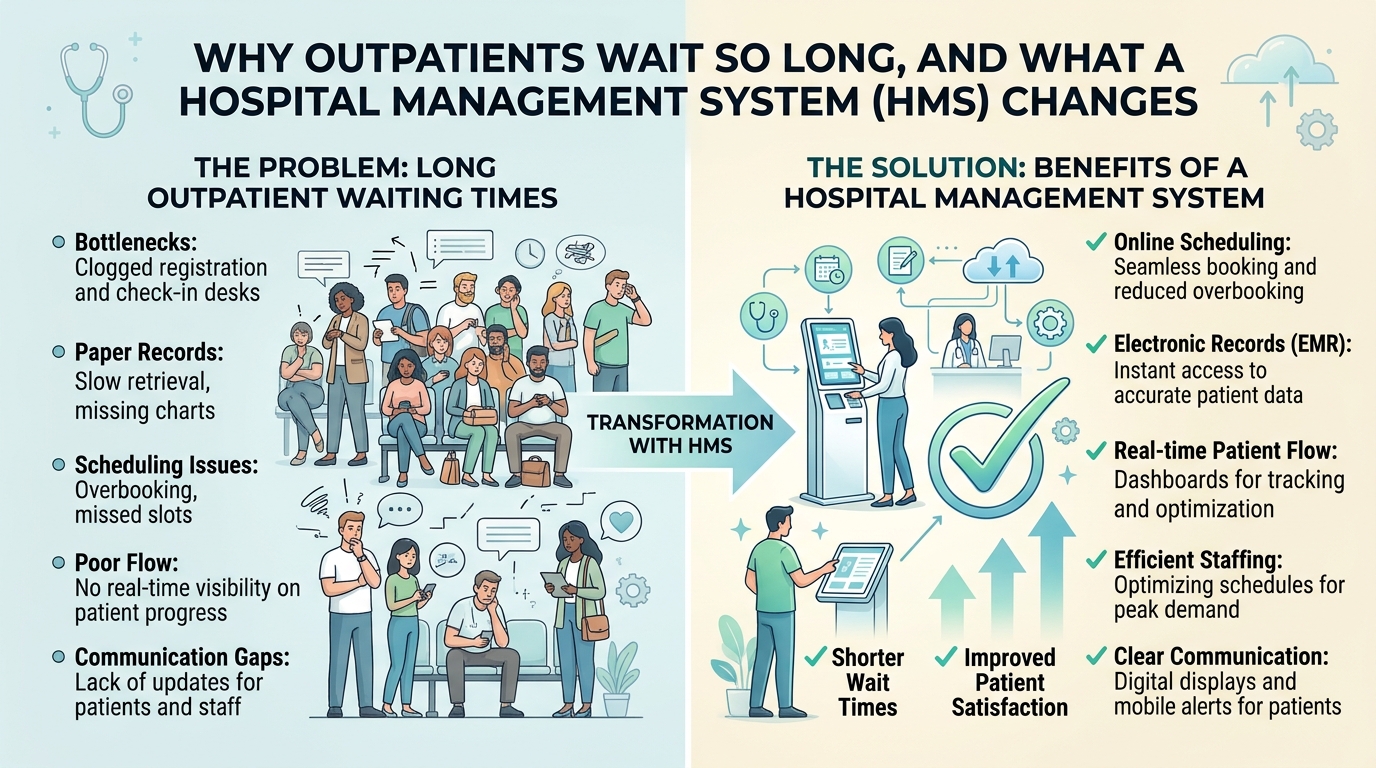
Walk into the outpatient area of many Kenyan hospitals and clinics on a busy morning and you will see the same picture. Benches are full. Patients hold paper cards. Staff move between rooms carrying files. Everyone is working hard, yet patients still spend most of their visit waiting rather than being seen.
The usual explanation is a shortage of doctors. Sometimes that is true. More often, much of the delay sits in the gaps between clinical steps: finding files, re-writing information, walking orders from one desk to another, and queueing to pay. Those gaps are exactly where a well-built hospital management system makes a difference.
Where the waiting really happens
A typical outpatient visit passes through several hand-offs:
- Registration, where the patient's details are captured or an old file is searched for.
- Triage, where vitals are taken and written down.
- Consultation, where the clinician reviews history, examines and orders tests or medicine.
- Payment, often at a separate cashier, sometimes more than once in a single visit.
- Laboratory or imaging, followed by a wait for results to come back to the clinician.
- Pharmacy, where prescriptions are read, checked against stock and dispensed.
Each step on its own may only take a few minutes. The problem is that each hand-off depends on paper moving physically, or on someone shouting a name across a corridor. When one desk slows down, every desk behind it backs up, and nobody can see the whole queue.
The hidden costs of paper files and disconnected desks
Paper-based or partly digital facilities tend to share the same pain points:
- Lost or duplicate files. A returning patient's file cannot be found, so a new one is opened and their history is effectively lost.
- Illegible or incomplete prescriptions, which slow the pharmacy and create risk.
- Revenue leakage. Services are delivered but never billed, or billed but never reconciled against cash and mobile money received.
- Claims friction. Insurance and SHA claims are delayed or queried because documentation is scattered across registers.
- No real picture for management. Administrators struggle to answer simple questions such as which departments are busiest, which drugs are running low, or how long patients actually wait.
What a hospital management system changes, step by step
A hospital management system is not just a digital filing cabinet. Its real value is that information follows the patient automatically, so staff stop acting as messengers.
Registration and a single patient record
Each patient gets one record, searchable by name, phone number or ID. Returning patients are found in seconds, and their history, allergies and past visits are there for the clinician. Duplicate records become far less common, and staff spend less time searching shelves.
Triage and live queue visibility
Vitals are entered once at triage and appear on the clinician's screen immediately. Every consultation room can see who is waiting, in what order and with what priority. Supervisors can spot a backlog building in one department and redirect staff before it becomes a crisis.
Orders that travel on their own
When a clinician requests a lab test or prescribes medicine, the order goes straight to the lab or pharmacy queue. Results come back into the patient record rather than on a slip of paper. Pharmacists see clear, typed prescriptions and current stock levels, which also helps with reordering and expiry tracking.
Billing and M-Pesa at the point of service
Charges are added automatically as services are ordered, so nothing is forgotten. With M-Pesa integration, patients can pay from where they are and the payment is matched to their bill without manual reconciliation. Finance teams get a clean daily record of what was billed, what was paid and through which channel. Insurance and SHA-covered visits can be flagged so the right documentation is captured from the start.
SMS reminders and updates
Bulk and automated SMS can confirm appointments, remind patients of follow-ups or clinic days, and notify them when results are ready. That reduces missed appointments and cuts the number of people who come in only to ask whether something is ready.
Reports management can actually use
Because every step is recorded, administrators can see patient volumes by department, common diagnoses, drug consumption, revenue by service and waiting patterns across the day. Decisions about staffing and stocking can be based on evidence rather than impressions.
What a system will not fix on its own
It is worth being honest. Software does not create more doctors, and a poorly planned rollout can make things worse for a while. Results depend on a few practical factors:
- Workflow fit. The system should follow how your facility really works, not force staff into a process designed for a different hospital.
- Training and champions. Each department needs people who are confident with the system and can support colleagues.
- Reliable infrastructure. Power backup, network coverage and a plan for working through outages matter as much as the software.
- Data protection. Patient information is sensitive. Access should be role-based, activity should be logged and data should be backed up securely.
How to start without disrupting your facility
Facilities that move successfully from paper to a digital system usually take a phased approach:
- Map the current patient journey. Walk through a real visit and note every hand-off, form and delay.
- Pick the most painful bottleneck first. For many, that is registration and records; for others, billing or pharmacy.
- Start with one department or service line, run it properly, then expand.
- Bring in existing data carefully. Decide what history needs to be digitised and what can be captured as patients return.
- Review after a few weeks. Ask staff and patients what has improved and what still slows them down, then adjust.
This approach keeps the facility running while the change happens and builds staff confidence along the way.
Talk to us about your facility
At Glomex Technologies we build hospital management systems for clinics, hospitals and health facilities across Kenya and the wider region, with M-Pesa payments, SMS and reporting built in, and room to shape the system around how your teams already work. Whether you are moving off paper for the first time or replacing a system that no longer fits, we are happy to start with a conversation about your patient flow and where the delays really are. Get in touch and tell us about your situation.
Share this post
Know someone who'd enjoy reading Why Outpatients Wait So Long, and What a Hospital Management System Changes?