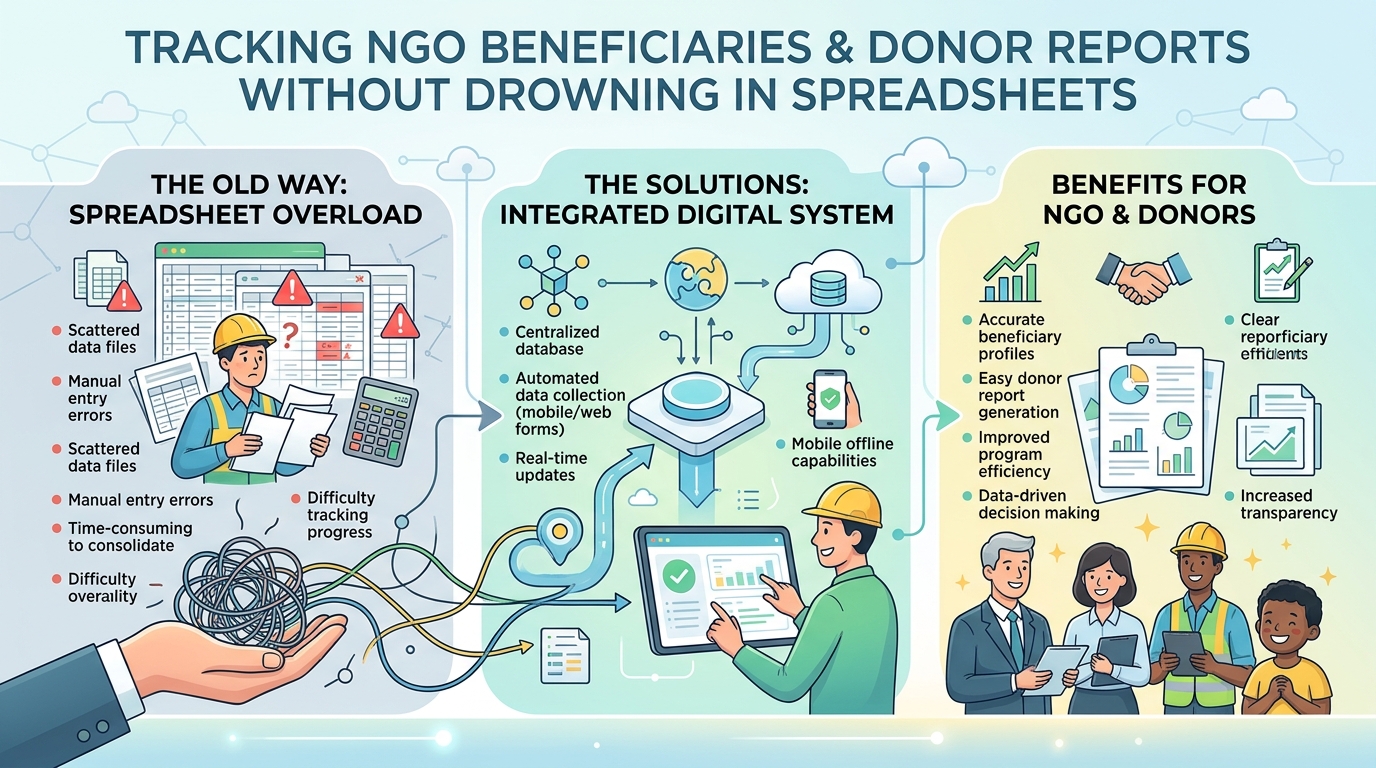
Most community organisations in Kenya start their record-keeping the same way: one spreadsheet for registrations, another for distributions, a WhatsApp group for field updates and a folder of scanned attendance sheets. It works while the programme is small. Then a second donor arrives, a new county is added, and someone is asked to produce a quarterly report by Friday. Suddenly the numbers in three files do not agree, and nobody is sure which one is right.
This post looks at why beneficiary data becomes so hard to manage, what a well-designed system changes, and how to move to one without disrupting work in the field.
Why the spreadsheet approach breaks down
Spreadsheets are not the enemy. The trouble is how they are used once a programme grows.
The same person is recorded more than once
A beneficiary registered at a community meeting in one ward may be registered again by a different officer at a clinic outreach a month later. Names are spelt differently, phone numbers change, and ID numbers are sometimes missing. Without a single register, duplicates creep in. That leads to double support for some people, missed support for others, and awkward questions from donors.
Field data arrives late and in pieces
Field officers often collect information on paper and type it up later, or send photos of forms. By the time it reaches the office, it has passed through several hands. Errors are introduced at each step, and the programme team is always looking at last month's picture.
Every donor wants a different report
One funder wants results broken down by gender and age group, another by sub-county, another by activity. When data sits in separate files, each report becomes a manual exercise of copying, filtering and reconciling. Staff who should be supporting communities spend days building tables instead.
Cash and voucher payments are hard to trace
Where programmes send support through M-Pesa, the payment records live in one place and the beneficiary list in another. Matching who was supposed to receive what against who actually received it is slow, and any gaps are hard to explain during an audit.
What a proper beneficiary management system does
A beneficiary system is simply one shared, structured place where every person, household, activity and payment is recorded once and linked together. The value comes from a few practical features.
A single register with duplicate checks
Each beneficiary gets one record. When an officer registers someone new, the system checks for likely matches by ID number, phone number and name, and flags them before a duplicate is created. Household members can be linked so you can see support at both the individual and household level.
Mobile data collection that works offline
Field officers use a phone or tablet app with the same forms they already understand. The app saves entries when there is no network and syncs when a signal returns, which matters in many rural areas. Required fields, drop-down lists and GPS tags reduce the mistakes that come from retyping paper forms.
Activities and services linked to people
Trainings attended, food parcels received, referrals made, school fees supported: each activity is recorded against the beneficiary's record. Over time you build a clear history for each person, which helps with follow-up and with showing longer-term outcomes rather than just one-off outputs.
M-Pesa disbursements tied to the register
Payments can be sent through an M-Pesa integration directly from an approved list, with each transaction recorded against the right beneficiary. Failed payments are flagged for follow-up, and finance teams can see exactly which approved recipients have and have not been paid.
Reports built from the same data
Because everything is in one place, reports become a matter of choosing filters: period, location, project, donor, gender, age band. Dashboards give managers a live view, and standard report templates can be set up for each funder so the quarterly scramble becomes a routine export.
Bulk SMS for communication and feedback
Built-in bulk SMS lets you notify beneficiaries about distribution dates, meeting changes or payment confirmations in English, Kiswahili or local languages. It can also support simple feedback loops, where people reply to confirm receipt or raise a concern, giving you an extra layer of accountability.
Data protection is not optional
Beneficiary records often include sensitive details: health status, household circumstances, ID numbers and phone numbers. Kenya has data protection legislation, and many donors set their own expectations as well. A good system should include:
- Role-based access, so a field officer sees only their area and a finance officer sees only what they need for payments.
- Audit trails that record who created, changed or viewed records.
- Consent capture at registration, recorded in the system rather than on loose paper.
- Secure hosting and regular backups, so a lost laptop or a crashed drive does not mean lost records.
Moving away from shared spreadsheets and personal phones is often the single biggest improvement an organisation can make to how it protects the people it serves.
Where AI can genuinely help
AI is not required to run a beneficiary system, but there are sensible places to use it:
- Smarter duplicate detection, catching records where names are spelt differently or transliterated in different ways.
- Drafting narrative reports from your data, which staff then review and edit, saving time on first drafts.
- Summarising open-ended feedback from SMS replies or survey comments so recurring issues stand out.
In each case a person stays in charge of the final decision. AI should save time on repetitive work, not decide who receives support.
Making the switch without disrupting the field
The fear with any new system is that it will slow down people who are already stretched. A careful rollout avoids that.
- Start with your current forms. Digitise what officers already use before adding new fields. Familiar questions make adoption easier.
- Clean and import existing data. Bring your spreadsheets in, resolve duplicates once, and agree which records are the source of truth.
- Pilot in one area or project. Let a small team use the system for a few weeks, gather their feedback and adjust before expanding.
- Train in person where possible. Short, practical sessions on the actual phones officers will use work far better than manuals.
- Set up donor reports early. Building each funder's template at the start shows quick value to management and finance.
- Plan for ongoing support. Staff change, programmes evolve and donors update requirements. Someone needs to maintain the system after launch.
Custom or ready-made?
Some organisations can work well with a configurable, ready-made platform, especially if their programmes follow common patterns of registration, activities and payments. Others run complex, multi-donor programmes with unusual eligibility rules or integration needs, where a custom build pays off. The right answer depends on your programmes, your team's capacity and how your reporting needs are likely to change over the next few years.
Let's talk about your programme
Glomex Technologies builds beneficiary management, data collection and reporting systems for NGOs and community organisations, with M-Pesa payments, bulk SMS and practical AI built in where they help. Whether you are wrestling with duplicate records, slow field data or last-minute donor reports, we would be glad to hear how your programmes run today and suggest a sensible next step. Get in touch with our team to start the conversation.
Share this post
Know someone who'd enjoy reading Tracking NGO Beneficiaries and Donor Reports Without Drowning in Spreadsheets?