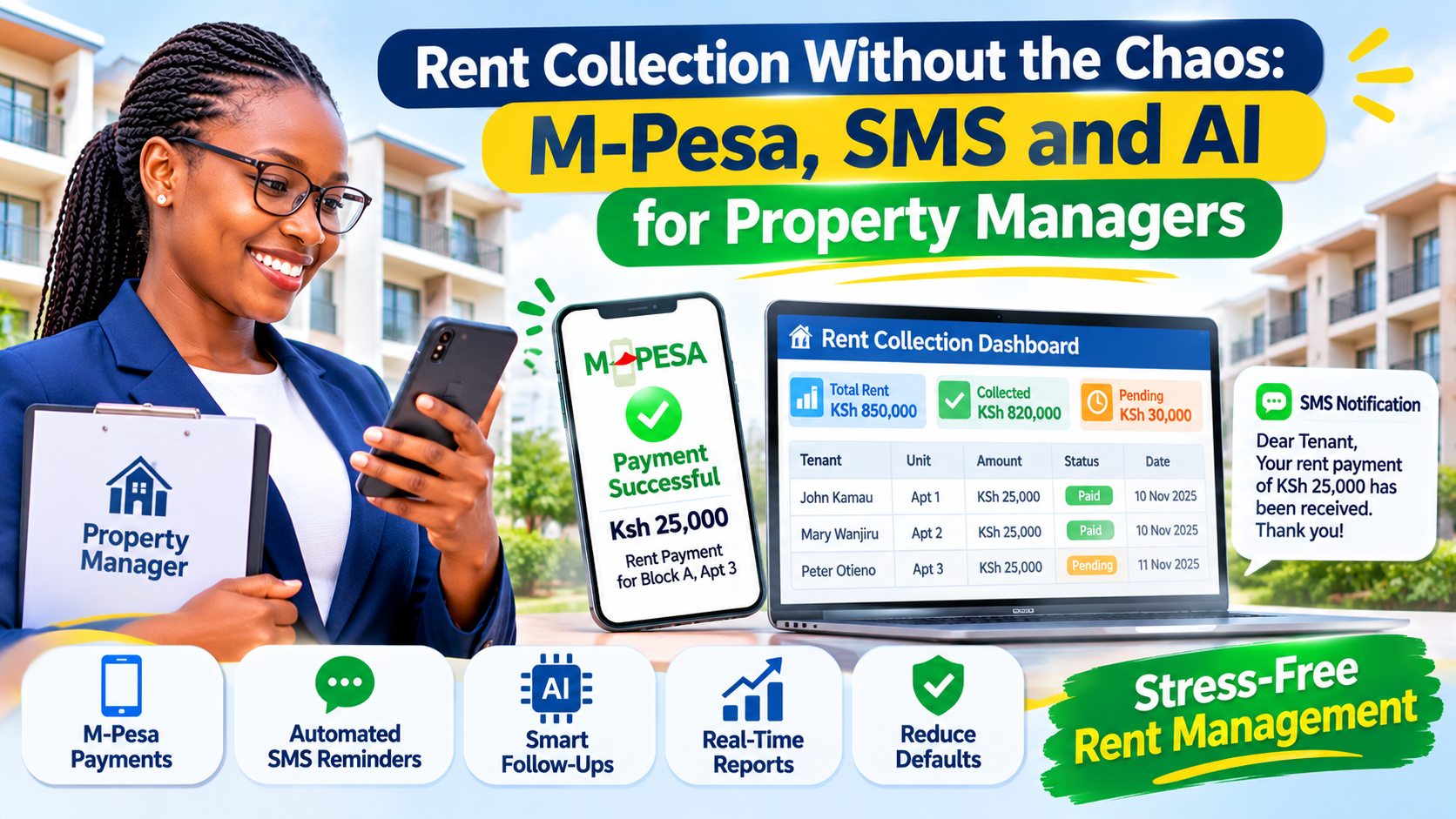
Ask any landlord or letting agent in Nairobi, Mombasa or Kisumu what takes up most of their week, and the answer is rarely the buildings themselves. It is the paperwork around them. Who has paid this month? Which M-Pesa message belongs to which unit? Did the caretaker really fix the leaking tap in Block C? Why is the owner asking for a statement that nobody has prepared yet?
Property management in Kenya has moved quickly to mobile money, but the systems behind it often have not. Many portfolios still run on a mix of notebooks, spreadsheets, WhatsApp groups and a phone full of payment confirmations. That works for a handful of units. It starts to fail as soon as a portfolio grows, or when more than one person is involved in collecting rent and handling tenants.
This post looks at where property management typically breaks down, and how a well-built system, using M-Pesa integration, SMS and practical AI, can fix it.
Where property management usually goes wrong
The problems tend to be the same whether you manage one apartment block or several estates across different towns:
- Unmatched payments. Tenants pay through a Paybill or till but enter the wrong account number, a nickname, or nothing at all. Someone then has to work out who paid what, often days later.
- Arrears discovered too late. Without a live view of balances, a tenant can fall two or three months behind before anyone notices.
- Reminders that depend on one person. If the agent is busy or away, reminders simply do not go out.
- Lost maintenance requests. Complaints arrive by phone call, text and in person. Some are fixed, some are forgotten, and there is no record of which.
- Slow owner reporting. Property owners, especially those living abroad, want clear monthly statements. Putting them together by hand eats days.
- Weak records for tax and disputes. When a tenant disputes a balance, or when it is time to prepare rental income records for KRA, the information is scattered.
Matching every M-Pesa payment to the right unit
The single biggest improvement most property managers can make is automatic payment reconciliation. When your Paybill or till is integrated directly with your management system, every payment arrives as structured data: the amount, the phone number, the account reference and the time.
The system then matches that payment to a tenant and unit. Where the tenant has used the correct unit number as the account reference, the match is instant. Where they have not, the system can fall back on the phone number registered to that tenant. Anything it still cannot place goes into a short review list rather than disappearing into a pile of SMS confirmations.
The result is a ledger that is always up to date. Balances, partial payments and overpayments are recorded the moment money arrives, and tenants can receive an automatic receipt by SMS.
Reminders tenants actually receive
Once balances are live, reminders become simple to automate. A sensible setup might look like this:
- A friendly reminder a few days before rent is due.
- A confirmation and receipt as soon as payment is received.
- A follow-up message to tenants with an outstanding balance after the due date.
- An escalation to the property manager when arrears pass a threshold you choose.
Bulk SMS works well here because it reaches every tenant regardless of the type of phone they use. Messages can be personalised with the tenant's name, unit and exact balance, which makes them clearer and harder to ignore than a generic group message.
Maintenance requests that do not get lost
Tenants judge a property largely on how quickly problems get fixed. A simple request system, through a tenant portal, a short code or an SMS keyword, gives every issue a reference number and a status. Caretakers and contractors can update jobs from their phones, and the tenant is notified when work is done.
Over time this builds a useful history. You can see which units generate the most repairs, which contractors respond quickly, and where money is being spent on the same problem again and again.
Where AI genuinely helps
AI is not a replacement for good records, but once the basic data is clean, it can take a lot of routine work off your team's plate. Practical uses include:
Smarter payment matching
AI can learn the patterns in how your tenants pay. If a tenant always pays from a relative's number, or always writes their house number in a particular way, the system can suggest the right match with a confidence level, leaving staff to approve rather than investigate.
Spotting arrears risk early
By looking at payment history, such as payments arriving later each month or rent being split into smaller amounts, the system can flag tenants who may be heading into difficulty. That gives you a chance to have a conversation early, rather than chasing months of arrears later.
Sorting maintenance requests
Tenants describe problems in their own words, often mixing English and Kiswahili. AI can read a message such as "maji haitoki jikoni since morning", recognise it as a plumbing issue, mark it as urgent and route it to the right caretaker.
Drafting owner reports and tenant replies
AI can produce a plain-language summary to accompany each owner's monthly statement, highlighting collections, arrears and repairs. It can also draft polite responses to common tenant queries for staff to review and send.
The important point is that AI should support decisions, not make them silently. A good system shows its reasoning and keeps a person in charge of anything that affects a tenant's money or tenancy.
Reporting for owners, agents and tax records
With payments, expenses and repairs in one place, reporting becomes a by-product rather than a monthly project. Owners can log in and see their own properties. Agents managing several owners can generate statements in minutes. And the business has clean, dated records of rental income and expenses to support its tax filings and its own accountant's work.
How to get started
You do not have to change everything at once. A practical path looks like this:
- Clean up your tenant register. Confirm units, tenants, phone numbers, rent amounts and current balances.
- Standardise payment references. Give every unit a clear account number and tell tenants to use it.
- Integrate M-Pesa collections. Connect your Paybill or till so payments flow straight into the ledger.
- Switch on automated SMS. Start with receipts and due-date reminders, then add arrears follow-ups.
- Add maintenance tracking. Give tenants one clear channel for reporting issues.
- Layer in AI. Once your data is reliable, introduce smarter matching, risk flags and request sorting.
Talk to Glomex about your properties
Every portfolio is different. A family managing a few blocks needs something lighter than an agency handling hundreds of units for multiple owners. At Glomex, we build custom property management systems with M-Pesa payment integration, bulk SMS and practical AI built in, designed around how your business actually works rather than forcing you into someone else's process.
If rent collection, arrears or owner reporting is taking more of your time than it should, get in touch and tell us about your situation. We will help you work out what to fix first and what a sensible system would look like for you.
Share this post
Know someone who'd enjoy reading Rent Collection Without the Chaos: M-Pesa, SMS and AI for Property Managers?