A few years ago, low-code platforms were the shortcut. They promised that a small team could assemble business apps with drag-and-drop screens and a little scripting, instead of waiting months for a full development project. Many organisations in Kenya and across East Africa took that route for internal forms, approval workflows and simple dashboards.
The ground has moved again. No-code tools now let non-technical staff build working apps with no scripting at all. Generative AI goes further: you describe what you need in plain language, and the system drafts the pages, the data structure and sometimes the logic for you. For a county department head, a hospital administrator, a school bursar or a SACCO manager, this raises a fair question: should we move, and if so, how do we do it without creating a mess?
Three steps on the same ladder
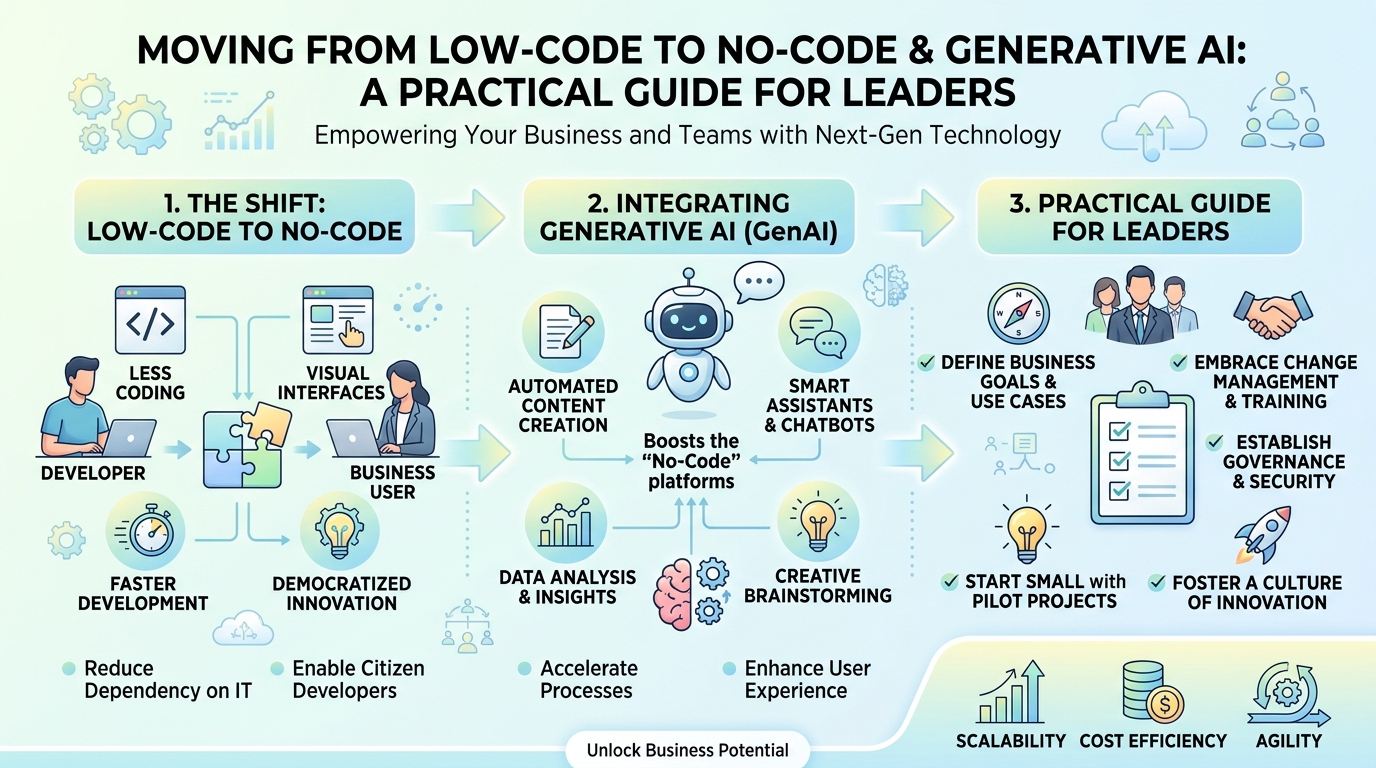
It helps to see low-code, no-code and generative AI as steps on one ladder rather than competing ideas. Each step removes another layer of technical effort from the person who has the business problem.
Low-code
Low-code tools give you visual building blocks but still expect someone who understands data models, logic and a bit of scripting. They suit IT teams who want to move faster, not business teams working alone.
No-code
No-code tools hide the scripting entirely. A procurement officer can build a requisition form, or an events coordinator can set up a registration page, by configuring options. The trade-off is that you are limited to what the tool allows.
Generative AI
Generative AI changes the starting point. Instead of choosing blocks, you write a description: a website for our clinic with service pages, a booking form and a contact section. The AI produces a first version you can refine. Our own AvelAI Web Generator works this way for websites, and the same approach is spreading to forms, reports, documents and internal tools.
What actually changes when you move
The biggest shift is not technical. It is about who builds and how fast ideas get tested.
- The people closest to the problem can build. The records officer who knows exactly why patient files go missing can sketch the fix herself.
- First versions arrive in hours, not weeks. That makes it cheap to try an idea, show it to colleagues and throw it away if it does not work.
- The bottleneck moves to quality and control. When anyone can build, the hard questions become: is the data correct, who can see it, and who maintains this when the person who built it moves on?
Where no-code and generative AI work well
In our experience, these tools shine when the task is self-contained and the cost of a mistake is low. Good examples include:
- Marketing websites and landing pages for a business, NGO campaign or event.
- Internal forms such as leave requests, asset requests or field reports.
- First drafts of documents, such as tender responses, policies or member communications, which a human then checks.
- Simple dashboards that read from a clean, existing data source.
- Prototypes to show stakeholders before committing to a full system.
Where they fall short
The same tools struggle when the work touches money, regulation, sensitive records or many connected systems. Be careful with:
- Payments and reconciliation. Matching M-Pesa transactions to the right member, student or invoice needs reliable integration, error handling and audit trails that a generated app rarely provides out of the box.
- Sensitive data. Patient records, learner information and member savings are subject to Kenya's data protection requirements. Where the data is stored, who can access it and how it is logged all matter.
- Core operations. A hospital's patient flow, a county's revenue collection or a SACCO's loan book need to work every day under load. These deserve proper engineering, testing and support.
- Integration. Connecting to existing finance systems, SMS gateways, biometric devices or government platforms is often where no-code tools hit their limits.
- AI accuracy. Generative AI can produce confident output that is wrong. Anything it drafts for a legal, financial or clinical purpose must be reviewed by a qualified person.
A practical path for making the move
You do not need a big programme to start. A sensible sequence looks like this:
- List what you already have. Note the spreadsheets, low-code apps and manual processes in use, who owns them and what data they hold.
- Sort by risk. Separate low-risk, self-contained tasks from those involving money, personal data or core operations.
- Hand low-risk work to no-code and generative AI. Let teams build websites, forms and drafts quickly, within agreed guidelines.
- Put core systems on solid foundations. Use proper platforms or custom builds for payments, records and anything regulators may ask about.
- Connect the two. Make sure the quick tools read from and write to your main systems through controlled integrations, not copied spreadsheets.
- Review regularly. Some quick builds will prove valuable enough to deserve a proper rebuild. Others should be retired.
Governance: keeping speed without chaos
The risk with no-code and generative AI is not that they fail; it is that they succeed too widely without oversight. Ten departments may each build their own version of the same register, with different data and no backups. A few simple rules help:
- Agree which tools are approved and where their data is stored.
- Keep a simple register of what has been built and who owns it.
- Never let personal or financial data sit in unapproved tools.
- Require human review of AI-generated content before it is published or acted on.
- Plan for handover so nothing depends on a single person.
How Glomex fits in
We work across the whole ladder, so we can be honest about which step suits each problem. For quick wins, AvelAI generates websites from a plain description, and tools such as TenderAI help draft and organise tender responses for human review. For core operations, our ready-made platforms for schools, hospitals, SACCOs and chamas, counties, retail and fleets come with M-Pesa payments, bulk SMS and AI features already built and tested. Where nothing off the shelf fits, our custom software, integration and AI automation teams build systems that the faster tools can safely plug into, backed by cloud hosting and managed support.
The aim is not to replace your people with AI, or to lock you into one approach. It is to let your teams move quickly where it is safe, and stand on reliable systems where it matters.
Let us talk about your situation
If you are weighing up low-code, no-code or generative AI, or you already have a patchwork of quick tools that needs bringing under control, we would be glad to help you map it out. Tell us what you are trying to achieve, and we will give you a plain-spoken view of what to build quickly, what to build properly and how to connect the two.
Share this post
Know someone who'd enjoy reading Moving From Low-Code to No-Code and Generative AI: A Practical Guide for Leaders?